



Picture a founder walking into a board meeting with a beautiful marketing report.
Impressions are up 300%. Followers have doubled. The last campaign video crossed half a million views. The marketing team is proud, and honestly, they worked hard for those numbers.
That same week, the company loses the biggest contract it has ever bid for. The procurement committee picked a competitor with a smaller social media following and a less exciting website.
Why?
Because nobody on that committee looked at the impressions. They asked a different question, mostly in conversations the founder was never part of: "Who are these people, and can we trust them with this?"
The competitor had a better answer to that question. Not because they posted more, but because their name meant something clear in the minds of the people who mattered.
That gap, between the numbers we measure and the reputation that actually wins business, is why we built AARI at Hustle Africa. In this article I want to explain what it is, how it works, and how you can use it to see your business the way the market sees it.
Who actually decides your reputation?
Here is something that took me years in this business to fully appreciate.
Your reputation is not what you say about yourself. It is not even what your marketing says. Your reputation is what your name signifies when you are not in the room.
And the rooms that matter most are rooms you will rarely enter:
Key Strategic Takeaways
The procurement committee comparing three suppliers.
The investment team deciding whether to take a second meeting.
The partnerships lead at a multinational, shortlisting local partners.
The editor deciding which expert to call for a quote.
The senior hire choosing between your offer and another one.
In each of those rooms, somebody says your name. Then there is a pause. What fills that pause is your reputation.
Sometimes the pause is filled with, "Oh, they are the best at this. Everybody knows that." Sometimes it is filled with, "I have seen their posts, but I am not sure what they actually do." And sometimes, painfully, nobody in the room has heard of you at all.
So the real question is not "how many people saw our content?" It is "what do the people who decide our future believe about us, and is that belief moving in the right direction?"
That is a harder question. It is also the only one that pays.
Why the usual marketing numbers mislead you
I am not against marketing metrics. They have their place. But most of the numbers founders see every month measure activity, not reputation. And activity can look very healthy while reputation stands still.
Let me show you what I mean, using the five numbers we hear about most often and what each one quietly misses.
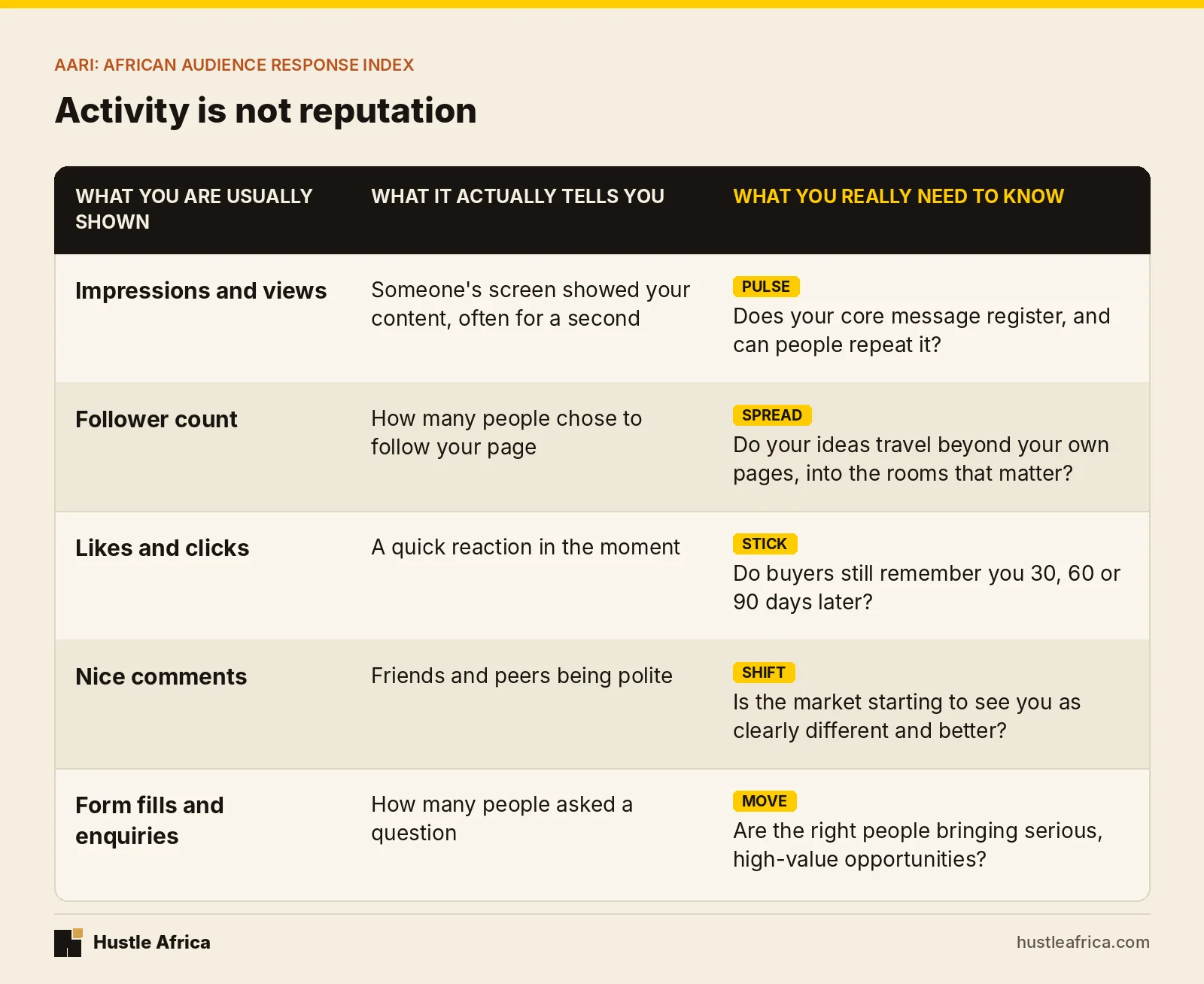
Look at that last row carefully. Many businesses celebrate a rise in enquiries, then discover most of them are price shoppers who drain the team's time and never buy. More enquiries is not the same as better enquiries.
The column on the right is what reputation is really made of. The trouble is that nobody hands you those answers in a monthly dashboard. You have to go and measure them on purpose.
Meet AARI: the African Audience Response Index
AARI stands for the African Audience Response Index. It is the framework we use at Hustle Africa to measure how the market actually responds to a business, from the moment people first notice you to the moment they decide to work with you.
The idea is simple. Instead of counting activity, we measure response. Every business gets a score out of 100, built from five pillars:
Key Strategic Takeaways
Pulse: does your message land?
Spread: does it travel?
Stick: do people remember you?
Shift: is opinion moving in your favour?
Move: does all of that turn into real business?
Why "African"? Because the way trust works in our markets is not a copy of how it works elsewhere. Relationships, referrals, the weight of a feature in a national newspaper or on TV, and the way a name travels through a sector: these things behave differently here. Frameworks designed for other markets often miss them.
AARI was built from our own work with African businesses since 2020. It reflects what we have seen move contracts, partnerships, and investments on this continent, not what looks good in a global marketing textbook.
The five pillars, in plain language
Think of the five pillars as a journey. Attention comes first, then distribution, then memory, then opinion, then action. If an early stage is weak, everything after it suffers. That is why the order matters.
1. Pulse: does your message land?
Pulse measures how quickly your work gets noticed and whether people can repeat what you do in their own words.
The test is almost embarrassingly simple. Ask five people who know your business to describe it in one sentence. If you get five different answers, or long, confused ones, your Pulse is weak.
A strong Pulse looks like this: new work gets noticed quickly, and people describe you the same way you would.
Where to start: tighten your one-sentence definition of what you stand for, and make sure it shows up in the first few seconds of everything you put out.
2. Spread: does it travel?
Spread measures whether your ideas, frameworks and milestones move beyond your own pages, without you paying to push them.
Are you being quoted? Do people reshare your thinking? Does your name come up in industry conversations, on panels, in the press, in WhatsApp groups you are not part of? If your content only lives on your own channels, it is talking to people who already know you.
A strong Spread looks like this: your ideas show up in places you did not put them.
Where to start: create things that are easy to share and worth repeating, such as a clear framework, a useful insight or a striking finding, rather than simply more posts.
3. Stick: do people remember you?
Stick measures whether people still remember you 30, 60 or 90 days after they first came across you, and come back on their own when it is time to decide.
This is where many busy businesses leak. They are seen, even shared, but they are forgotten by the time the budget is approved.
A strong Stick looks like this: buyers return without being chased, and your name comes up unprompted when a decision is being made.
Where to start: be consistent. Same message, same look, same promise, again and again. Memory is built through repetition, not novelty.
4. Shift: is opinion moving in your favour?
Shift measures whether the market's view of you is changing for the better, and whether you are seen as clearly different from the alternatives.
Be careful here. Lots of polite, positive comments can hide a real problem: people like you, but they still think you are the same as everyone else. Liked is not the same as distinct.
A strong Shift looks like this: people describe you as the leader, the specialist, the one to call, not just "one of the good ones."
Where to start: earn third-party validation. Credible media coverage, respected voices vouching for you, and public proof of your results move opinion far more than anything you say about yourself.
5. Move: does it turn into business?
Move measures how reliably all that attention turns into serious opportunities: qualified enquiries, partnerships, invitations and contracts.
It is about quality and speed, not volume. Ten enquiries from the right people beat a hundred from price shoppers.
A strong Move looks like this: the right people reach out, and deals move faster because they already trust you.
Where to start: look at every call to action and every route to buying. Make sure what you are asking for matches where the decision-maker actually is in their journey.
The four bands, and the trap most businesses are stuck in
Your five pillar scores combine into one AARI score out of 100. That score places you in one of four bands.
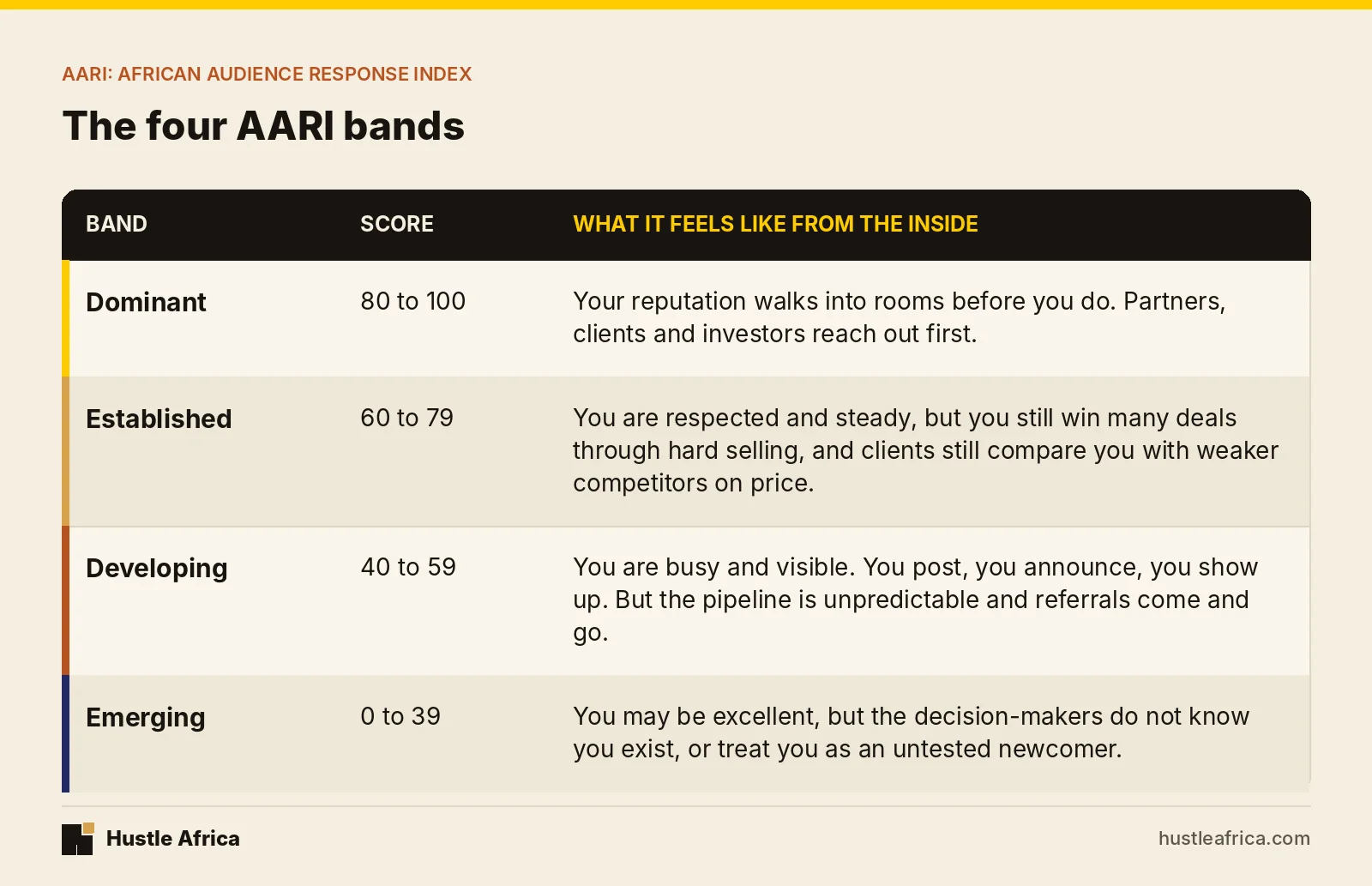
In our work with more than 150 African brands, the biggest group by far sits in the Developing band. About 44% of the businesses we have assessed are there.
We call this the Developing Plateau, and if you are honest, you may recognise it.
These businesses are not lazy. They are often working harder than anyone on content and announcements. But they are stuck, because more activity does not fix what is holding them back. What they lack is a clear, memorable story and the kind of outside validation that makes people take them seriously.
Here is the good news. Moving from Developing to Established is rarely about spending more on adverts. It usually comes down to three things: a sharper message, credible third-party recognition, and a smoother path from interest to purchase.
What a scorecard looks like in practice
Let me walk you through an example, so you can see how the numbers turn into decisions. This is an illustration, not a real client.
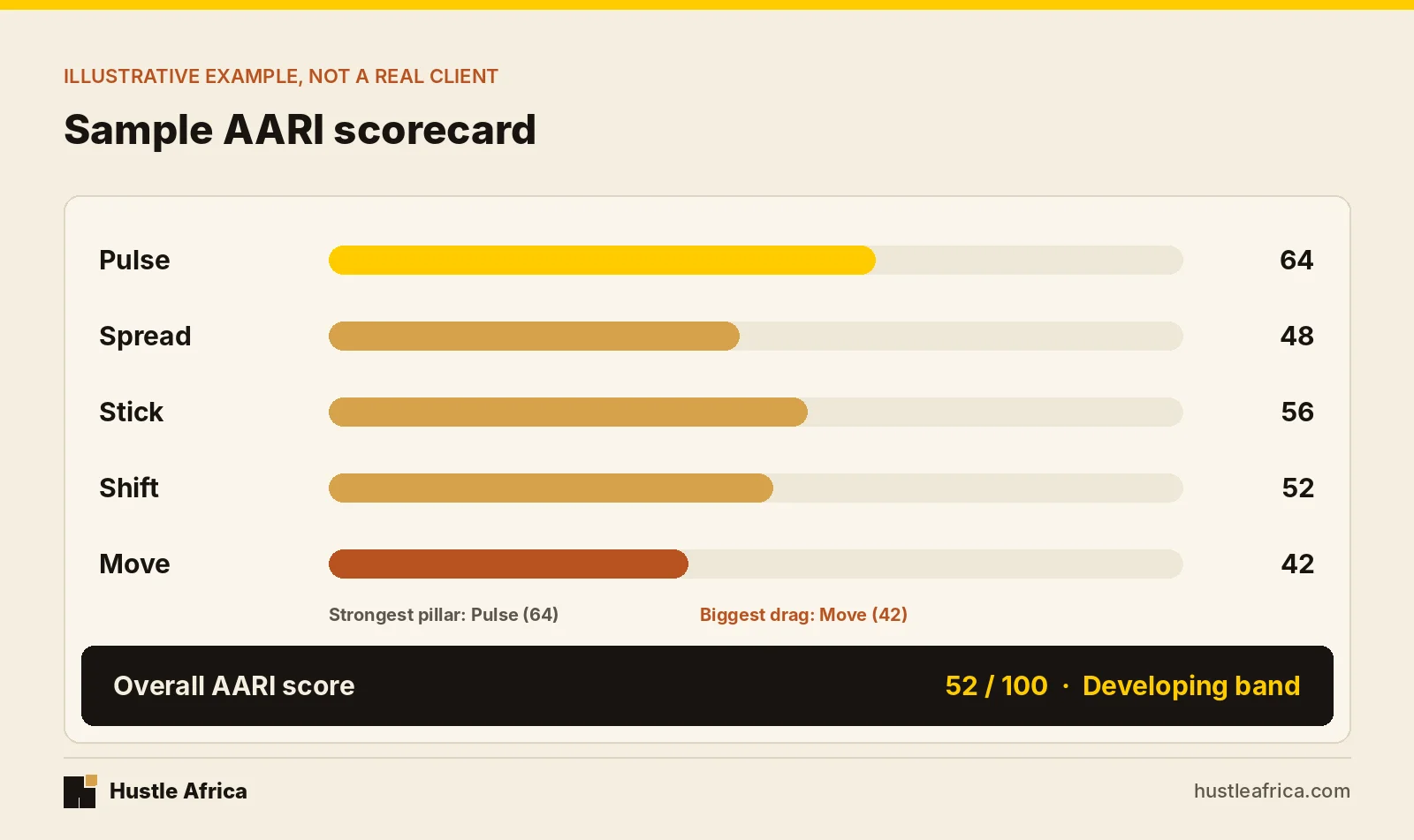
Imagine a professional services firm in Lagos. Good team, good work, steady clients. Its AARI scorecard comes back like this:
What does this tell the founder?
The strength is Pulse. People understand what the firm does. The message is reasonably clear. That is a good foundation, and it means the firm does not need to start again from scratch.
The biggest drag is Move. Attention is not turning into the right opportunities. People know the firm and think well of it, but the path from "I have heard of them" to "let us sign" is broken somewhere.
So the most valuable next step is not more content and not a new logo. It is a hard look at every call to action, every proposal, every sales conversation and every route a serious buyer takes, to make sure the ask fits where that buyer really is.
This is the real value of AARI. It stops you from spending money on the wrong problem. Without it, this firm might have doubled its social media budget, which would have pushed Pulse up a little and left the real leak untouched.
How a full AARI assessment works
There are two ways to use AARI.
The quick way is our free interactive scorecard on the AARI page of our website. You move a slider for each pillar based on your honest view of your business, and it gives you an overall score, your strongest pillar, your biggest drag, and a suggested next step. It takes a few minutes, and it is a good conversation starter for your leadership team.
The thorough way is a full assessment by our team. Your own opinion of your business is useful, but the market's opinion is what counts, so a full assessment goes and gathers it. We use three main sources:
Key Strategic Takeaways
Audience research: speaking with and surveying the people whose opinion matters to your business, to test what they understand, remember and believe about you.
Media and sentiment analysis: looking at what is being said about you, and how, in the press and in public conversation.
Conversion analysis: tracing how interest turns, or fails to turn, into real opportunities.
Why we measure every six months
Reputation does not change overnight, and one score is only a snapshot. Our retainer clients get a fresh AARI scorecard every six months, so they can see real movement over time. A typical cycle looks like this:
Key Strategic Takeaways
Month 0: a baseline assessment across all five pillars, to find exactly what is holding the business back.
Months 1 to 2: sharpen the core message and create ideas and assets built to be shared.
Months 3 to 4: earn credible media coverage and raise the leadership's public profile.
Month 5: fix the path from interest to purchase, and open doors through our network.
Month 6: measure again, against the baseline and against named competitors, to show what has really changed.
That last point matters. A score on its own is interesting. A score that shows you gaining or losing ground against the competitors you actually face is something you can act on, and something you can show your board or your investors.
Start measuring what actually matters
Let me bring it back to that founder with the beautiful marketing report.
The problem was never the effort. The problem was that the numbers on the report could not answer the question the procurement committee was asking. AARI is built to answer that question: when your name comes up in a room you are not in, what happens next?
Here is a simple exercise you can do this week, even before you use any tool:
Key Strategic Takeaways
Pulse: ask five people to describe your business in one sentence. Do the answers match?
Spread: search for your company name. How much of what you find did you not post yourself?
Stick: think of a prospect who went quiet three months ago. Would they remember you today?
Shift: ask a trusted client how they would describe the difference between you and your closest competitor.
Move: look at your last ten enquiries. How many were the kind of client you actually want?
Wherever your answers feel weakest is probably where your reputation is leaking.
When you are ready to see your full picture, try the free AARI scorecard or commission a full assessment with Hustle Africa.